













What is the project
This project aims to transform the management of working conditions across the three retail brands (Continente, Continente Modelo and Bom Dia) through the digital integration of three critical dimensions of the work system:
- Ergonomic conditions (physical dimension of work)
- Self-Protection Measures and safety procedures (technical-regulatory dimension)
- Organisational Factors impacting safety and operational performance (organisational and cultural dimension)
All information was migrated, structured and integrated into the OutSystems digital platform “Colaborador Seguro”, enabling centralization, traceability, comparability across stores, continuous updating and evidence-based decision support. The project transitioned the management of working conditions from a fragmented and partially static structure to a centralized, dynamic and data-driven digital system.
The total workforce across the operational formats comprises 26,280 employees, representing the reference population for the organisational assessment.
Ergonomic Dimension
Within the ergonomic component, a total of 1,101 microtasks were assessed across the three brands: 387 in Continente, 350 in Continente Bom Dia and 364 in Continente Modelo. The Ergonomic Baseline represents a structured diagnostic model of working conditions and follows a hierarchical aggregation logic:
- Microtask level
- Macrotask level
- Process level
- Global baseline level
The assessment integrates:
- The 14 classical EWA items (including postures, repetitive movements, manual handling, and work organisation factors)
- Second-level assessment methods (REBA, RULA, NIOSH and Mital), applied when higher analytical precision is required
Each requirement is weighted and converted into criticality levels, forming a structured ergonomic profile that enables comparability across stores.
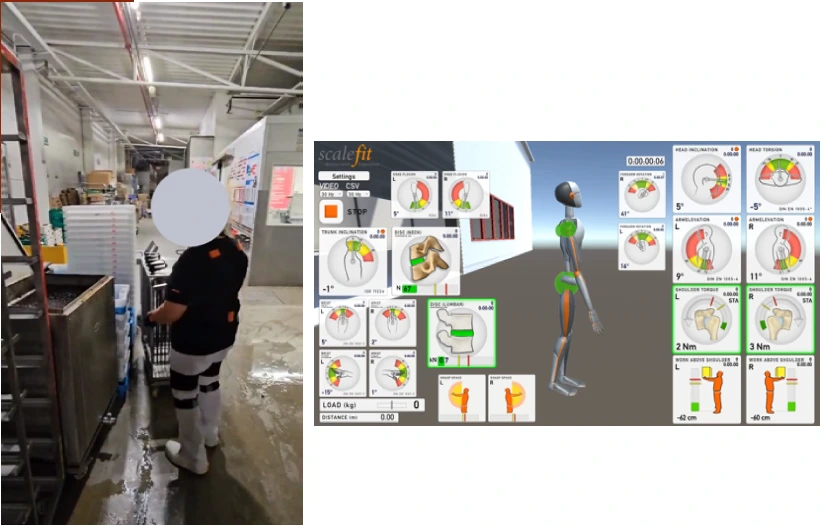
In addition to structured task evaluation, posture and movement analyses were conducted using the Scalefit assessment tool supported by Xsens motion capture technology, enabling objective biomechanical quantification and comparative risk scoring for WMSD prevention.
This project ensured the full update and digital operationalisation of the previously developed Integrated Ergonomic Index (IEI), consolidating its monitoring capacity within a centralized digital environment.
Self-Protection Measures Dimension
Prior to the project, Self-Protection Measures were recorded through partially dispersed and non-integrated systems.
The intervention included:
- Full mapping and review of existing safety and emergency procedures
- Standardisation of documentation structures
- Migration into a centralized digital repository within OutSystems
- Implementation of traceability mechanisms ensuring version control and systematic updating
This transformation enables immediate access to emergency protocols, strengthens regulatory compliance monitoring, improves audit readiness and ensures structured linkage between safety procedures and broader risk indicators.
Organisational Dimension
Within the organisational component, a scientifically validated framework comprising 68 Organisational Factors distributed across 9 domains was developed through a PRISMA-based systematic literature review and a Delphi study.
The framework was operationalised for application in the food retail context.
Each factor was assessed according to:
- Relevance to food retail operations
- Applicability within store-level work systems
- Priority level using the GUT Matrix (Gravity, Urgency, Trend)
The GUT matrix enabled structured prioritisation by scoring each factor across:
- Gravity – potential impact on safety and operational performance
- Urgency – immediacy of required intervention
- Trend – likelihood of escalation if not addressed
This approach allows objective ranking of organisational risk drivers within the retail environment.
The quantitative assessment follows a structured statistical analysis plan, including:
- Descriptive statistics
- Exploratory factor analysis
- Domain prioritisation based on weighted GUT scores
- Comparative regional analysis (North, Centre and South)
- Correlation analysis between organisational domains and ergonomic risk levels
A national sampling plan (n = 379, 95% confidence level) was defined to ensure representative data collection across regions.
Project at a glance
Focus: Integrated digital management of ergonomics, safety and organisational conditions
Scope: Three retail brands
Platform: OutSystems “Colaborador Seguro”
Microtasks assessed: 1,101
Organisational Factors identified: 68 (9 domains)
Total workforce (population): 26,280 employees
Sample size (95% confidence level): 379 employees
Strategic alignment: Retail 5.0
Objectives
- Digitize and integrate the management of working conditions.
- Update the Ergonomic Baseline across all three brands.
- Centralize and structure Self-Protection Measures.
- Identify and prioritise Organisational Factors influencing safety and work performance.
- Enable quantitative and evidence-based decision-making.
- Promote a coherent, monitorable and continuously improving work system.
What we delivered
The project resulted in the implementation of an integrated digital management system enabling:
- Full update and digitalization of the Ergonomic Baseline across the three brands, integrating the 14 EWA items and second-level assessment methods into the OutSystems platform.
- Operational integration of the Integrated Ergonomic Index (IEI) within a centralized monitoring architecture.
- Mapping, updating and digitalization of all Self-Protection Measures, ensuring centralized documentation, regulatory traceability and systematic updating.
- Development and operationalisation of a validated framework of 68 Organisational Factors, including prioritisation through the GUT matrix.
- Definition of a statistically robust sampling plan to support national-level organisational assessment.
The integrated digital architecture enables cross-analysis between ergonomic risk levels, organisational domains and safety procedures, supporting multidimensional and data-driven intervention planning.
Metrics / KPIs
Microtasks assessed
Value: 1,101
Notes: Across three brands
EWA items integrated
Value: 14
Notes: Digitalized in platform
Second-level ergonomic methods
Value: 4
Notes: REBA, RULA, NIOSH, Mital
Organisational Factors identified
Value: 68
Notes: 9 domains
Total workforce (population)
Value: 26,280
Notes: Reference population
Sample size
Value: 379
Notes: 95% confidence level
Digital platform
Value: Implemented
Notes: OutSystems
Summary
This project developed and implemented an integrated digital model for managing working conditions in food retail, aligned with the Retail 5.0 framework. The initiative addressed the need to centralize and structure previously fragmented information related to ergonomics, safety procedures and organisational risk factors.
The project integrated three core dimensions of the work system into a unified digital architecture within the OutSystems platform “Colaborador Seguro”. Within the ergonomic dimension, 1,101 microtasks were assessed and digitally consolidated, ensuring structured monitoring through the operational integration of the Integrated Ergonomic Index (IEI). Self-Protection Measures were mapped, standardized and migrated into a centralized system, strengthening regulatory compliance, traceability and emergency preparedness.
In parallel, a scientifically validated framework of 68 Organisational Factors across nine domains was operationalised for the food retail context. A structured sampling plan was defined to assess these organisational dimensions, with a representative sample of 379 employees (95% confidence level) drawn from a total workforce of 26,280.
The resulting system enables multidimensional risk prioritisation and supports evidence-based decision-making through integrated ergonomic, safety and organisational indicators.


.webp)



