







.webp)


What is the project
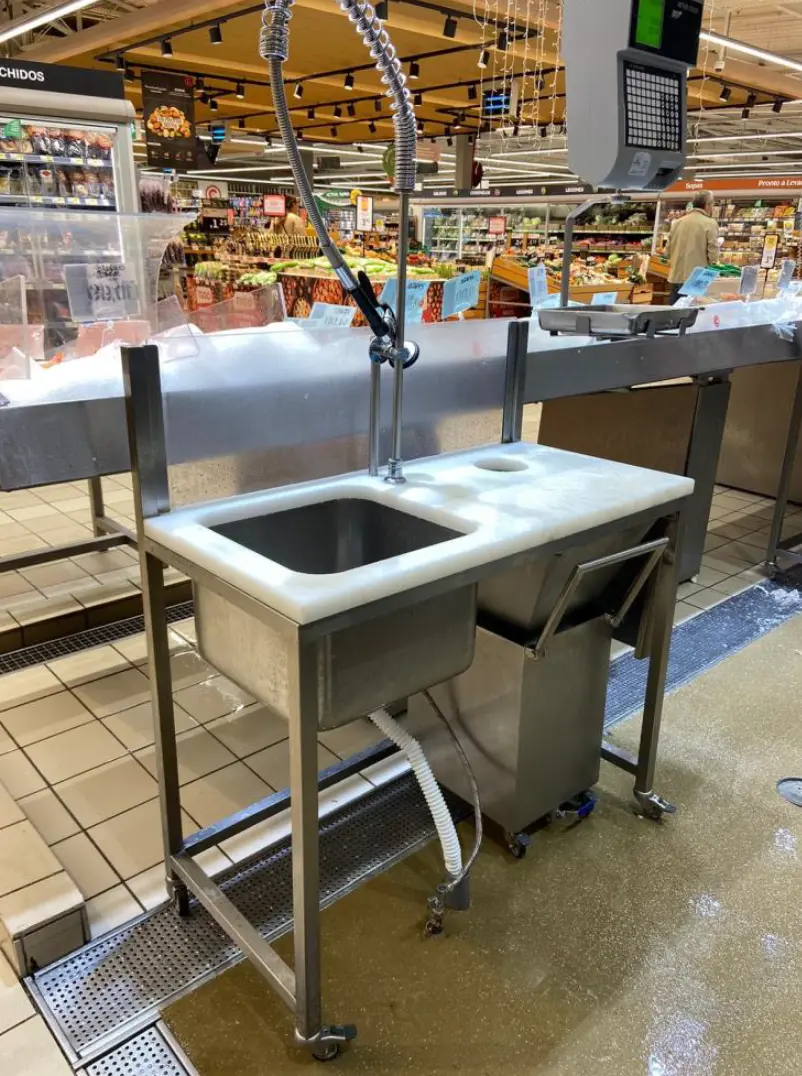
The Fish Trimming Table project is an applied industrial pilot developed within a Lean Retail and ergonomics-driven improvement program in food retail. The intervention focuses on redesigning the fish preparation workstation to address operational waste, ergonomic risk (RULA), and safety issues identified in the existing viscera cleaning process. The solution integrates product design, Lean Product Development and poka-yoke principles, and was prototyped and validated in a real store context in collaboration between the University of Minho and a food retail partner. The redesigned table enables continuous waste flow during fish preparation, eliminating repetitive drawer handling and reducing non-value-added micro-tasks.
Project at a glance
This is a workstation-level redesign implemented in a real fishmonger section. The solution replaces the removable viscera drawer with a fixed funnel and a mobile cart with two reservoirs (liquids/solids), integrated under the table. The new configuration supports continuous operation, reduces manual lifting and awkward postures, prevents liquid spillage to the floor, and standardizes the cleaning procedure through a defined work instruction. The intervention targets measurable gains in ergonomics, safety, hygiene and operational efficiency.
Objectives
- Reduce ergonomic load and musculoskeletal risk associated with viscera handling and cleaning tasks.
- Eliminate non-value-added micro-activities in the cleaning process and reduce cycle time.
- Improve occupational safety and hygiene by minimizing manual handling of waste and liquid spillage.
- Standardize the cleaning procedure and reduce process variability between operators.
- Develop a scalable and retrofittable solution compatible with existing fish preparation tables.
What we delivered
- 3D-designed and prototyped fish trimming table with integrated funnel and dual-reservoir collection cart.
- Replacement of the removable viscera drawer with a gravity-assisted waste funnel.
- Integration of liquid drainage and solid waste collection into a single continuous-flow system.
- Implementation of positioning guides (poka-yoke) to ensure correct placement of the collection cart.
- Definition of standardized work instructions for the cleaning and waste disposal process.
- Pilot validation in a real retail store environment with before–after operational assessment.
Metrics / KPIs
Cleaning cycle time reduction
Value: ~47%
Notes: Based on comparison between original viscera drawer cleaning process and redesigned solution
Average cleaning time per cycle (before)
Value: ~195 seconds
Notes: Baseline process with drawer removal, drainage, disposal and transport
Average cleaning time per cycle (after)
Value: ~103 seconds
Notes: Continuous-flow waste handling with funnel and cart
Estimated annual time savings
Value: ~90 hours/year
Notes: Assumes average daily cleaning frequency per table
Estimated annual labor cost savings
Value: ~840€/year
Notes: Indicative value; dependent on local labor cost
RULA average score (before)
Value: High risk (≈6–7)
Notes: Indicates need for immediate intervention
RULA average score (after developed solution)
Value: Acceptable / low risk (≈2–3)
Notes: Significant reduction in musculoskeletal risk
Manual lifting of viscera drawer
Value: Eliminated
Notes: Drawer removal replaced by gravity-fed funnel
Liquid waste spillage to floor
Value: Eliminated
Notes: Direct reduction of slip and contamination risk
Number of handling steps in cleaning task
Value: Reduced
Notes: Elimination of non-value-added micro-activities
Process standardization
Value: Implemented
Notes: Standard operating procedure introduced
Need for additional handling equipment
Value: None
Notes: Solution integrated into existing workstation
Replicability to other stores
Value: High
Notes: Retrofit compatible with existing tables
Summary
The Fish Trimming Table project redesigns the fish preparation workstation in food retail to improve ergonomics, safety, and operational efficiency. Developed through Lean Product Development and tested in a real store environment, the solution replaces the traditional viscera drawer with a gravity-fed funnel and a dual-reservoir cart that separates liquid and solid waste. This continuous-flow system eliminates repetitive handling, reduces cleaning time and ergonomic risk, prevents spills, and standardizes the cleaning process while remaining compatible with existing preparation tables for easy replication.

.webp)



